Fitness-Proportionate. This method calculates an expected number of times an individual is allowed to reproduce. This is accomplished by what is termed "roulette wheel" sampling. The roulette wheel can be considered as a pie chart. Each individual is assigned a slice of the pie. The size of that slice depends upon its fitness compared to the average fitness of the population, in that:
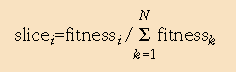
Once the roulette wheel (pie) is divided up, it is spun N times (the number of individuals in the population). Each pair of spins produces two parents, which in turn will produce two offspring. Based on the divisions of the roulette wheel, this then represents the probability of a given individual being selected to reproduce. Since the more fit individuals have a bigger slice of the pie, they also have a greater chance of being selected.
Rank. This method ranks individuals according to their fitness. This is a relative ranking with the least fit being given a rank of 1 and the most fit given a rank of N. The expected number of times an individual will be allowed to reproduce is based on that ranking. There are various ways to generate this expected value, which will not be covered here. However, a simplistic approach would be very similar to that of the fitness-proportionate example:
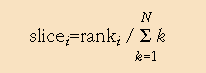
Once this value is calculated, the roulette wheel selection method can be used to combine parents to produce offspring.
Tournament. This method incorporates a biased, random selection process in choosing individuals for reproduction. Typically, two individuals are selected at random from the entire population. A random number between 0 and 1 is then generated. If this value falls below a given value (for example, 0.8), then the individual with the higher fitness is put into the parent pool. Otherwise, the individual with the lower fitness is selected. From this pool pairs of parents can be selected in any number of ways for recombination.
Steady-State. This is not so much a selection process as it is a population replacement process. In many instances, the entire parent population is replaced by their offspring. In a steady-state environment, most of the parents are retained and only the least fit are replaced by offspring of parents with high fitness.
Random. Random pairs of individuals are chosen for reproduction. Parents may or may not be allowed to reproduce with themselves.