Victor is an independent consultant in Silicon Valley. He is presently writing a book on device-driver development for Windows NT and Windows 95. He can be contacted at 73553 .3533@compuserve.com.
When DOS was king, a vibrant market for real-time 80x86 systems existed. Many small manufacturers produced single-board PCs that served both as an embedded system and as a user interface. Even IBM made an "Industrial PC." But they were all DOS-based machines, employing sophisticated ISRs hooked into the 8254 timer hardware interrupt (IRQ 0). This DOS environment allowed you to easily create algorithms that fully exploited every real-time machine cycle of the motherboard microprocessor. The proliferation of the mighty TSR hooked to IRQ 0 was probably due to the demands of this real-time market.
With the introduction of Windows, however, we are saddled with the inability to do real-time work. For example, a 66-MHz 80486 running DOS can process timer interrupts at a frequency of 20,000 Hz with a ten-microsecond ISR latency. The same machine running Windows 95 using the standard virtual device driver (VxD) calls for manipulating the timer interrupt might be able to process timer interrupts at a frequency of 500 Hz with a 300-microsecond ISR latency. Further, the latency gets worse for the Windows machine when the ISR is in a DLL instead of a VxD.
In this article, I'll discuss why documented methods are inadequate for increasing the accuracy and responsiveness of the real-time aspects of Windows. I'll also point out how these artificial limitations can be overcome and present a utility that modifies Windows 95 internals to reduce the number of instructions required per interrupt from approximately 3200 to about 660. Finally, I'll provide a new real-time utility for Windows 95 that will narrow the gap between the real-timer power of the new machines and the real-time power harnessed by Windows 95. This utility installs interrupt-service routines into the kernel and processes interrupts at frequencies over 40,000 Hz with a ten-microsecond ISR latency on a 66-MHz 80486 machine. The essence of this algorithm is an undocumented Windows function. When this function is used it causes a twist in the internal architecture of Windows, making it more real-time sensitive.
The current generation of PCs provide awesome real-time power, which, unfortunately, is underutilized by Windows 95. Consider VTD_Begin_Min_Int_Period(int PeriodLength), the Windows 95 routine that increases the sensitivity of its scheduler. This call can easily be upgraded to increase its efficiency by at least a factor of 10. The parameter (int PeriodLength) decreases the timer interrupt (IRQ 0) period, thus increasing the timer interrupt frequency. This increases the accuracy and responsiveness of the scheduler, which is hooked into IRQ 0. To illustrate the inefficiency of this call, I'll calculate the number of instructions executed during a minimum interrupt period on an ancient 386 16-MHz machine. I'll then use this instruction count as a benchmark, and calculate the possible minimum interrupt period on the new, faster machines. The discrepancy between this actual limit and the artificial Microsoft limit is surprising.
The calculation in Figure 1 uses dimensional analysis to conclude the number of instructions executed in a single timer interrupt when the minimum interrupt period is reduced to its Microsoft limit of one millisecond. (This limit is derived from the minimum parameter passed to VTD_Begin_Min_Int_Period().) Figure 1 shows that Microsoft allows you to interrupt the machine every 3200 instructions. For comparison, the calculation in Figure 2 shows the minimum interrupt period on a 150-MHz Pentium, assuming at least 3200 instructions per interrupt period.
The calculation shows that if a timer interrupt can be accommodated every 3200 instructions, then on a 150-MHz Pentium, we should be able to accomodate a minimum interrupt period of .045 milliseconds for no other reason than Windows imposes an unnecessary limit on the parameter passed to VTD_B_MIP(). This illustrates that Microsoft has not even upgraded one of its most important real-time functions, even though all that is required is a change in parameter limits.
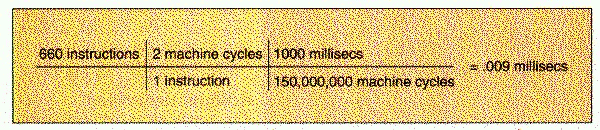
Certainly, the real-time internals of Windows 95 can be improved. But, by how much? Figure 3 calculates the minimum interrupt period that might be achieved given an entirely new, more-efficient internal interrupt architecture. A minimum interrupt period of 0.009 milliseconds represents a frequency of greater than 100,000 Hz. This is too fast even to do I/O work on the slow ISA bus. We need to be on a PCI or VESA bus to exploit this power.
Windows supplies several internal components, including the Virtual Machine Manager (VMM), VxDs, BIOS, and Dynamic Link Libraries (DLLs). The utility I present here uses the VMM, the programmable interrupt controller virtual device (VPICD.386), and the timer virtual device (VTD.386). The VMM, VPICD.386, and the VTD.386 are instantiated in WIN386.EXE. The VMM is the first component loaded, then VPICD.386, and finally the VTD.386.
The VMM provides a large variety of services to applications and to the device-specific components. These services fall into more than 15 categories including memory-management services, virtual machine interrupt and callback services, primary scheduler services, time-slice scheduler services, event services, timer services, and processor fault services. Figure 4 shows the hierarchical relationship between the VMM and other components.
The VPICD.386 virtualizes the interrupt controller and presents the functionality to the virtual machines running the application software. The virtualization process involves receiving a hardware interrupt indication and knowing which virtual machine owns it. It also involves trapping requests for interrupt controller services and arbitrating the actual state of the interrupt controller with the state of the interrupt controller as seen by the requesting application. For example, when the application sends an end of interrupt (EOI), the VPICD.386 provides a response to the application indicating it was written to the interrupt controller hardware, whereas, in most cases, it is not actually written to the controller.
The VPICD.386 initializes by setting up interrupt-service routines for every interrupt request line (IRQ) on the master and slave programmable interrupt controllers. These ISRs are either global or owned. When a global hardware interrupt is generated, it is reflected into any virtual machine that is currently running. When an owned hardware interrupt is generated, it is reflected into the virtual machine that owns it; see Figure 4.
The VTD.386 virtualizes the hardware timer, presenting services to other virtual devices. These services involve reporting information about the internals of the VTD.386, such as providing the present minimum timer interrupt period. They also involve changing the internals of the VTD.386. For example, the VTD.386 offers a function to change the minimum timer interrupt period, VTD_ Begin_Min_Int_Period().
The VMM is the first component loaded and it creates IDT entries for all the hardware interrupts on the interrupt controllers. In Figure 5, area 1 shows the architecture of the system after the VMM creates the initial IDT and adds the vectors. The VPICD.386 loads next and calls into the VMM to hook all the interrupts. The VPICD.386 uses the VMM's fault hooking services for this operation. In a sense, it creates a secondary IDT for all the interrupts from the interrupt controllers and creates vectors to default ISRs. Furthermore, the VPICD.386 reads the programmable interrupt controller registers to determine which are owned and which are global. Thus its own interrupt hooking services know which interrupts other users can be allowed to hook. Area 2 of Figure 5 shows the architecture of the system after the VPICD.386 is loaded and all the hardware interrupts have been provided with default ISRs.
The VTD.386 loads hooking the timer interrupt, IRQ 0, which is connected to the 8254 timer. It uses the VPICD virtualization functions for this operation. The VTD.386 obtains exclusive ownership of IRQ 0. In Windows 95, it reprograms the timer to interrupt every 20 ms. (In Windows 3.1 it uses 50 ms, and in Windows for Workgroups it uses 20 ms.) It also arbitrates all further requests to change this minimum interrupt period; see Figure 5, area 3.
The process for handling an interrupt is predictable. The interrupt vectors from the VMM IDT to the VMM ISR. The VMM ISR saves all the registers, does some administrative work and then passes control to whoever has hooked the interrupt with the fault hooking services of the VMM. This almost always is the VPICD .386 code. The VPICD.386 handles all the administrative work of virtualizing the interrupts. Its first action is to send out an EOI, then issue a CLI. Next, it passes control to whoever has virtualized the interrupt with the VPICD.386 services. In the case of IRQ 0, which has been hooked by the VTD.386, control passes to the ISR within VTD.386.
The process for handling a single interrupt is simple, as long as you assume the microprocessor is in a single monolithic mode. However, the 80386 generation of microprocessors has protected paging circuitry and runs in three different hardware modes. All of these hardware modes must be handled by the operating-system software-interrupt structure. Windows 95 creates three corresponding software modes for this purpose:
Arbitration between the modes is done in the VPICD.386. The VPICD.386 keeps a table of vectors for each different mode. When the VPICD.386 loads and initializes all the vectors, it uses the VMM fault hooking services to hook each interrupt 3 times, once for each mode. It uses Hook_PM_Fault(), Hook_ V86_Fault(), and Hook_VMM_Fault() from the VMM fault hooking services. When an interrupt occurs, it goes through the IDT, which never changes, and the VPICD.386 directs the vector as a function of the mode of the microprocessor. Generally the ISRs do similar work in the different modes. Figure 6 shows the architecture of the system when all the interrupts are hooked in all the different modes.
With the technical background out of the way, I'll now turn to the algorithm which provides for this fast interrupt processing. At this point, the technique should be rather obvious -- you hook the interrupt service routine mechanism closer to the hardware so it does not go through all the software components every time it executes. You do not use the standard virtualization functions of the VPICD.386 because the ISR would only get control after the interrupt processing goes through the VMM and the VPICD.386 code. Instead, you hook the hardware interrupt with an undocumented function, or more correctly, you hook the hardware interrupt by using a documented function in an undocumented manner. Quite simply, you hook the hardware interrupt with the Hook_XX_Fault() routines. Even though the official Microsoft documentation clearly states that this function cannot be used for hooking hardware interrupts, it can. Officially, these routines are provided only for hooking software interrupts.
The VxD in Listing One hooks the IRQ 0 timer interrupt, reprograms the timer to interrupt at a higher frequency, steals all the interrupts which occur, and only passes control to the original interrupt handler at the original frequency. This hooking code is complicated because the interrupt-service routine no longer uses the VPICD.386 to administer the specifics of handling the programmable interrupt controller chip, such as sending out the EOI command. Figure 7 shows the architecture of the system when the timer interrupt (IRQ 0) is hooked. The VxD code is initialized and uninitialized when standard VxD system messages are received. Figure 8 provides an explanation of a few important procedures.
Listing One demonstrates the viability of this algorithm. However, not all the demands of the system are satisfied. Some additional features should be added to make the utility more robust. Specifically, some VTD.386 functions are unreliable because they are unaware that the timer has been reprogrammed and these VTD .386 functions receive unexpected values when they read the timer registers. This problem can be eliminated by overriding VTD_Begin_Min_Int_Period(), VTD_ End_Min_Int_ Period(), VTD_Get_ Real_Time(), and TD_ Update_System_Clock(). The new functions must maintain an internal database for the timer.
Fast interrupts are hardly the only enhancement needed to make Windows 95 an adequate real-time operating system. Another simple (yet important) enhancement is ensuring that the system interrupts are not turned off for long periods of time. This is such an important point that analyzing the entire system for excessively long periods of cleared interrupts is warranted. One extremely offensive module is the file system. It turns off system-level interrupts for periods of several milliseconds, and a sensitive real-time system can only tolerate periods of cleared interrupts for a few hundred microseconds. In Windows 3.1, this is a difficult problem because the offensive file system is hard to replace. In Windows 95, however, you have installable file systems, and you can easily replace the offensive default file system with a real-time file system.
Another important enhancement involves the implementation of a real-time scheduler. The real-time scheduler needs to be preemptive. That is, if some event occurs in an ISR which precipitates rescheduling, the rescheduling must take place at that instant. In addition to being preemptive, the scheduler should use an algorithm that respects the temporal requirements of the various tasks. This refers to how the scheduler decides which task runs when several tasks are ready to be executed. Some popular algorithms are rate monotonic, least-laxity first, earliest-deadline first, and maximum-urgency first. Also, the scheduler should support numerous priorities. Most dedicated real-time operating systems support at least 256 levels of priorities. Windows' lack of such a real-time scheduler may be the biggest impediment to its becoming a truly real-time operating system.
If you really wanted to pick nits, you could reprogram the master and slave 8259 programmable interrupt controller so it runs in special fully nested mode, instead of running in fully nested mode. Of all the different modes of the 8259 programmable interrupt controller, this is the most real-time sensitive. It speeds up interrupt servicing by 50 to 120 instructions.
Even if we add a real-time file system, we still have to deal with the problem that Windows has no specifications for the maximum duration of disabled interrupts. Hopefully, Microsoft will publish this in the future.
Are fast interrupts a big deal? Yes. The interrupt overhead in unmodified Windows is so bad that it precludes involving the system board in any relevant real-time processing. This is truly a shame because of the awesome power of the new system-board microprocessors. Not only do they have greater computational power, but they have greater real-time functionality. (The 80586/Pentium has a 64-bit counter of system clock cycles, which allows near-picosecond time stamps and never rolls over.) Intel has already cracked this market with its ProShare video conferencing package. This is the first product to use system-board microprocessor CODECs instead of peripheral-card DSP CODECs. Surely, a more-real-time sensitive Windows would cause a flood of such products to appear. We could do sound-card work without a sound card, speech-processing work with a DSP speech card. The new 80x86 PCs can win work from the peripheral cards in the same way they won work from the mainframes.
;-
; File Name..........: VHKD.ASM
; File Description...: Installs interrupt hooks to demonstrate the
;  undocumented fault hooking process.
; Author.............: Victor Webber
;-
; Build Notes:
;-
;   set include=\ddk\include
;   masm5 -p -l -w2 hk.asm;
;   link386 hk,vhkd.386,,,hk.def
;   addhdr vhkd.386
;
; The following segment must be placed into hk.def
;
; LIBRARY VHKD
; DESCRIPTION VHKD VIRTUAL DEVICE (VERSION 1.0)
; EXETYPE DEV386
; SEGMENTS
;  _LTEXT PRELOAD NONDISCARDABLE
;  _LDATA PRELOAD NONDISCARDABLE
;  _ITEXT CLASS ICODE DISCARDABLE
;  _IDATA CLASS ICODE DISCARDABLE
;  _TEXT  CLASS PCODE NONDISCARDABLE
;  _DATA  CLASS PCODE NONDISCARDABLE
; EXPORTS
;  VHKD_DDB @1
;
;-
; Operation Notes:
;-
;  1) Add device=vhkd.386 to the [386Enh] section of the SYSTEM.INI file
;  2) Open this VxD and call functions from a DLL.
;
;
;               A S S E M B L E R   D I R E C T I V E S
;
.386p
;
;                      I N C L U D E   F I L E S
;
INCLUDE VMM.INC
;
;                     E X T E R N A L   L I N K S
;
;
;                   E Q U A T E S
;
; The device ID  get your own ID from vxdid@microsoft.com
VHKD_VXD_ID             EQU 28C2h
VERS_MAJ                EQU 1
VERS_MIN                EQU 0
VERSION                 EQU ((VERS_MAJ SHL 8) OR VERS_MIN)
;- Equates used in reprogramming the 8254
; Number of reg 0 ticks which equal 1 milli sec
TMR_MTICK               EQU 04A9h
; The count down value in Windows 3.1
TMR_W31_CNT_DWN         EQU (TMR_MTICK*50)
; The count down value in Windows for Workgroups
TMR_WWG_CNT_DWN         EQU (TMR_MTICK*20)
TMR_OLD_CNT_DWN         EQU TMR_WWG_CNT_DWN
; Count down value for a tick every 15 milli secs
TMR_NEW_CNT_DWN         EQU (TMR_MTICK*15)
; 8254 Registers
CTRL_8254               EQU 043h
RWCNT_8254              EQU 034h
DATA_8254               EQU 040h
; 8259 values
VPICD_SP_EOI_0          EQU 60h
VPICD_CMD_M8259         EQU 20h
; Identifies interrupt to hook
TMR_IRQ0                EQU 050h
; Mode id
VMM_MODE_ID             EQU 0
PM_MODE_ID              EQU 1
V86_MODE_ID             EQU 2
CFLAG                   EQU 1
;
;                 S T R U C T U R E S
;
;
;
HK_ST     STRUC
;
; State of the hook system
wSt                     dw  ?
 ; Known uninitilized state
 ;HK_UNINIT      EQU 1
 ; All fault hooks initialized
 ;HK_INIT        EQU 2
;
; Frequency counters
dwNewFreq               dw  ?
dwOldFreq               dw  ?
;
; Old 8254 count down value
dwOldTmrCntDwn          dw  0
; New 8254 count down value
dwNewTmrCntDwn          dw  0
;
; System Accumulator
dwCntDwnAccum           dw  0
;
; System VM Handle
ddSysVM                 dd  0
;
; Array to hold old vectors
aVctr                   dd  3 dup (?)
HK_ST     ENDS
 ; Known uninitilized state
 HK_UNINIT      EQU 1
 ; All fault hooks initialized
 HK_INIT        EQU 2
;
;        V I R T U A L   D E V I C E   D E C L A R A T I O N
;
Declare_Virtual_Device VHKD, VERS_MAJ, VERS_MIN, _VhkdVxDControl, \
    VHKD_VXD_ID, Undefined_Init_Order, \
    _VhkdAPIHandler, _VhkdAPIHandler,
;
;           R E A L   M O D E   I N I T I A L I Z A T I O N
;
VXD_REAL_INIT_SEG
_real_init proc near
    mov      ah, 9
    mov      dx, offset claim
    int      21h
    xor      ax, ax          ; set up to tell Windows its okay
    xor      bx, bx          ; to keep loading this VxD
    xor      si, si
    xor      edx, edx
    ret
_real_init endp
claim     db  VHKD.386  VHKD  v. 1.0,0dh,0ah
          db  Copyright (c) 1995 and 96 Victor Webber. All Rights Reserved.
          db  0dh,0ah,$
VXD_REAL_INIT_ENDS
;
;                D A T A   S E G M E N T S
;
VxD_DATA_SEG
;-
; State Vars

sHK     HK_ST < HK_UNINIT, 0, 0, TMR_OLD_CNT_DWN >
;-
; API jump table
VhkdAPICall    label dword
                dd  offset32 _HkGetNewFreq
                dd  offset32 _HkGetOldFreq
VHKD_API_MAX EQU ( $ - VhkdAPICall ) / 4
VxD_DATA_ENDS
;
;           L O C K E D   C O D E   S E G M E N T
;
VxD_LOCKED_CODE_SEG
;
BeginProc   _VhkdAPIHandler
; - In: ebp.Client_AX :: function index
;
; - Description:
;  - This is the handler which funnels all service calls.
; - Out:
;  - Calls indexed function
; - Return:
;  - ebp.Client_EFlags :: CFLAG set is error
;  - ebp.Client_EFlags :: CFLAG clear is error
;  - See individual function
;
    movzx    eax, [ebp.Client_AX]            ; get callers AX register
    cmp      eax, VHKD_API_MAX               ; valid function number?
    jae      short fail
    and      [ebp.Client_EFlags], NOT CFLAG  ; clear carry for success
    call     VhkdAPICall[eax * 4]            ; call through table
    ret
fail:
    or       [ebp.Client_EFlags], CFLAG
    ret
EndProc     _VhkdAPIHandler
;-
BeginProc _VhkdVxDControl
; - In: void
;-
; - Description:
;  - Process system messages
; - Out:
;  - Call message handlers
; - Return:
;  - void
;-
    Control_Dispatch Sys_Critical_Init, _VhkdCritInitMsg
    Control_Dispatch Sys_Critical_Exit, _VhkdCritExitMsg
    clc
    ret
EndProc _VhkdVxDControl
;
BeginProc _VhkdCritInitMsg
; In: void
;
; - Description:
;  - Process Crit Init message.  This message occurs
;  during system initialization.
; - Out:
;  - Filles database with control information
;  - Init Fault Hooks
;  - Init first stage of tmr
; - Return:
;  - cy clr :: success, everything installed
;  - cy set :: error, nothing has been installed
;
    VMMcall  Get_Sys_VM_Handle

    mov      sHk.ddSysVM, ebx
    ; Install hooks, but keep hook system uninitialized.
    call     _HkInstallHooks
    jc       CI_EXIT
    ; Increase frequency of hook system
    call     _HkScheduleFreq
    clc
    CI_EXIT:
    ret
EndProc _VhkdCritInitMsg

;
BeginProc _VhkdCritExitMsg
;
; - Description:
;  - Process Crit Exit message
; - Out:
;  - Uninit Fault Hooks
; - Return:
;  - cy clr :: error, nothing has been installed
;
    ; Reset hook system
    call     _HkUnScheduleFreq
    clc
    ret
EndProc _VhkdCritExitMsg
;
BeginProc _HkInstallHooks
; - In: Void
;
; - Description:
;  - Hook the Timer faults. This should be the last
;  hook of these faults. No Hook should occur after this.
; - Out:
;  - Call Hooking procedures
;  - Fill structure with address of old fault hooks
; - Return:
;  - cy set :: error, no handlers installed
;  - cy clr :: success
;

    push     esi
    mov      eax, TMR_IRQ0
    mov      esi, OFFSET32 _HkPmIRQ0FaultHook
    VMMcall  Hook_PM_Fault
    jc       short HK_ERR
    mov      sHK.aVctr[PM_MODE_ID*4], esi

    mov      esi, OFFSET32 _HkV86IRQ0FaultHook
    VMMcall  Hook_V86_Fault
    jc       short HK_ERR
    mov      sHK.aVctr[V86_MODE_ID*4], esi

    mov      esi, OFFSET32 _HkVMMIRQ0FaultHook
    VMMcall  Hook_VMM_Fault
    jc       short HK_ERR
    mov      sHK.aVctr[VMM_MODE_ID*4], esi
    HK_ERR:
    pop     esi
    ret
EndProc _HkInstallHooks
;
BeginProc _HkScheduleFreq
; - In: void
;
; - Description:
;  - Reprograms the 8254 to interrupt at a higher frequency.
;  - Changes database for higher frequency
; - Out:
;  - Reprograms 8254
;  - Sets minimum interrupt period reload variable
; - Return:
;  - void
;
    ; Turn off interrupt
    cli
    ; Initialize hook system variables
    mov      sHK.wSt, HK_INIT
    mov      sHK.dwCntDwnAccum, TMR_NEW_CNT_DWN
    ; Load new count down into 8254
    cCall    _HkReload8254 < TMR_NEW_CNT_DWN >
    ; Write reload values into structure
    mov      sHK.dwNewTmrCntDwn, TMR_NEW_CNT_DWN
    ; Turn on interrupts
    sti
EndProc _HkScheduleFreq
;
; H O O K   P R O C S
; - In: void
;
; - Desc:
;  - ISRs for the PM mode, V86 mode, and the VMM mode
;  - All registers have been saved prior to the ISR being called.
; - Out:
; - Call another function
; - Return:
;  - void
; - Uses:
;  - eax
;
BeginProc _HkPmIRQ0FaultHook
    mov      eax, PM_MODE_ID
    call     _HkGenIRQ0FaultHook
    ret
EndProc _HkPmIRQ0FaultHook
BeginProc _HkV86IRQ0FaultHook
    mov      eax, V86_MODE_ID
    call     _HkGenIRQ0FaultHook
    ret
EndProc _HkV86IRQ0FaultHook
BeginProc _HkVmmIRQ0FaultHook
    mov      eax, VMM_MODE_ID
    call     _HkGenIRQ0FaultHook
    ret
EndProc _HkVmmIRQ0FaultHook
;
BeginProc _HkGenIRQ0FaultHook, PUBLIC
; eax = FAULT ID
;
; - Desc:
;  - Checks if critical frequency is reached.  Increment variables
; - Out:
;  - Increment Variables
; - Return:
;  - void
; - Uses:
; - Nothing
;
    ; Check if timer initialize, exit if not
    cmp      sHK.wSt, HK_UNINIT
    je       short GEN_EXIT
    ;Increment the count for new frequency
    inc      sHK.dwNewFreq
    ; Check if old frequency reached
    sub      sHK.dwCntDwnAccum, TMR_NEW_CNT_DWN
    jc       GEN_EXIT
    ; Send EOI to 8259
    mov      al, VPICD_SP_EOI_0
    out      VPICD_CMD_M8259, al
    ret
    GEN_EXIT:
    ;Increment the count for old frequency
    inc      sHK.dwNewFreq
    mov      sHK.dwCntDwnAccum, TMR_OLD_CNT_DWN
    call     sHK.aVctr[eax*4]
    ret
EndProc _HkGenIRQ0FaultHook, PUBLIC
;
BeginProc _HkUnScheduleFreq
; - In: void
;
; - Description:
;  - Resets 8254 to original state
; - Out:
;  - Reprograms 8254
;  - Resets hook system control variables
; - Return:
;  - void
;
    ; Turn off interrupt
    cli

    ; Uninitialize the hook system variables
    mov      sHK.wSt, HK_UNINIT
    ; Load original count down into 8254
    cCall   _HkReload8254 < TMR_OLD_CNT_DWN >
    ; Turn on interrupts
    sti
EndProc _HkUnScheduleFreq
;
BeginProc   _HkGetNewFreq
; - In: ebp :: pointer to client register structure
;
; - Desc:
;  - Reports frequency count for new 8254 period
; - Out:
;  - Read hook system structure
; - Return:
;  - Client_AX :: Frequency count
;

    mov     ax, sHK.dwNewFreq
    mov     [ebp.Client_AX], ax
EndProc     _HkGetNewFreq
;
BeginProc   _HkGetOldFreq
; - In: ebp :: pointer to client register structure
;
; - Desc:
;  - Reports frequency count for old 8254 period
; - Out:
;  - Read hook system structure
; - Return:
;  - Client_AX :: Frequency count
;

    mov     ax, sHK.dwOldFreq
    mov     [ebp.Client_AX], ax
EndProc     _HkGetOldFreq
;
BeginProc   _HkReload8254, PUBLIC
; - In: Word value to write into 8254
_HkRld STRUC
     dd ?  ;bp
     dd ?  ;ret
rl1  dd ?
_HkRld ENDS
;
; - Desc:
;  - Reload the 8254 with a new IPC
;  - Interrupts should be disabled throughout this process.
; - Out:
;  - Write value into 8254
; - Return:
;  - void
;

    push    ebp
    mov     ebp, esp
    mov     al, RWCNT_8254
    out     CTRL_8254, al
    mov     ax, WORD PTR [ebp.rl1]
    out     DATA_8254, al
    shr     ax, 8
    out     DATA_8254, al
    pop     ebp
    ret
EndProc _HkReload8254
VxD_LOCKED_CODE_ENDS
    END