Dr. Dobb's Journal July 2006
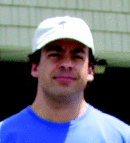
Paul Sepe
Employer: Self-employed
Job: Database developer
DDJ: What exactly do you do when you say you develop databases?
PS: I write the core database software for customers who have a need for high-performance, large database engines. Most of my customers so far have been in the pharmaceutical industry.
DDJ: What do you find satisfying or rewarding about your job?
PS: The fact that I've usually been presented with a blank slate and just some requirements. I've started the code from scratch and seen it through to completion, and that's very satisfying. Also, the freedom that it affords me. I like to travel around—I drive around North America a couple times a year [in a VW with 900,000 miles on it], exploring restaurants—and it lets me travel and still keep working wherever I am.
DDJ: What's the most challenging aspect of your job?
PS: Probably the biggest [challenge] is getting the software in the door in the first place. It's hard to explain how one guy writing software on his own can, in many cases, beat a more generalized solution from a big company.
DDJ: What emerging trends excite you?
PS: In the late 1980s, I was working with databases of a few dozen megabytes. Less than a decade later, the pharmaceutical databases my software managed were in the gigabytes. Now, I'm seeing datasets in the terabytes. But, while we're very good at producing and storing vast quantities of data, especially numbers, it is in some ways getting harder to retrieve it. Data warehouses have become data tombs. I'm looking forward to developing tools that will resurrect buried data.

Bryan McCormick
Employer: YouService
Job: J2EE programmer
DDJ: You're responsible for server-side programming at a small start-up company. What do you like about that job?
BM: It's very flexible. It's a small company. I was the first employee here. So I really get to build the company and the product up from the ground.
DDJ: What do you find challenging about your position?
BM: Like most start-ups, I have to do everything, from racking servers to setting up all the code and really designing the code from the start. It's challenging, in that you've got an open field to work with and you've got to create something that works.
DDJ: What have you found that makes your job easier?
BM: Definitely having the Web as a resource, and having open-source code out there. Just having a lot of other developers out there that you can ask questions of and just talk to and [bounce] ideas off of.
DDJ: So a support community, in other words.
BM: Yeah, and that's where I think Java really excels. [You've] got other people out there. A lot of this stuff is being done by others, and you really get a lot of help. If you bump into a problem, you can throw a question out there and there'll be dozens of people who have an answer for you.

Scott Westfall
Employer: SlickEdit Inc.
Job: Director of Software Development
DDJ: What do you do as Director of Software Development?
SW: I wear two hats: I'm the project manager, which means overseeing schedules, assigning work to team members, things like that; and I'm also the product manager, which is more about the actual products that we create, what features they contain, prioritizing defects, and planning the mix of features that will be in each release.
DDJ: What's particularly challenging about your job?
SW: It's the same thing I find challenging everywhere. Milestones are by far the most challenging thing. Programming would be great if we could just code for coding's sake, but the business of software development is about delivering a specified functionality by a planned release date. So I build schedules based on estimates and try to keep the work on track, but schedules are very often incomplete, and things go wrong, so hitting milestones is by far the biggest challenge.
DDJ: What have you found makes your job easier?
SW: My team. We've got very much a shared vision about what programming should be like and the kinds of things that editors should do for you. This group needs less management than any group of employees that I've ever worked with. I like to think I make a big contribution, but this team would be building great software even if I wasn't here.