On the other hand, undergraduate enrollments in computer science have taken a nosedive. Nationwide, universities are reporting undergraduate computer-science applications are down 30 percent. Ironically, the reason given for the decrease at the undergraduate level is the same as the increase in graduate programs — a poor job market. Apparently, the perception is that there is a glut of programmers out there and finding a job will be problematic.
If not computer science, where are all these undergraduates then going? According to a recent survey conducted by The Chronicle of Higher Education (http://chronicle.com/), 16.6 percent of this year's freshmen expect to major in business, with 12.6 percent in arts and humanities. Alas, only 9.1 percent of 2001-02 freshmen expect to major in engineering, 3.3 percent in computer science, and 2.2 percent in "technical" subjects (which, according to the survey, includes computer programming). These figures were arrived at by interviewing 281,064 freshmen entering 421 four-year institutions in 2001, and assumes a nationwide freshman population of 1.2 million full-time students. Overall, estimates peg the total number of undergraduate students at about 16.5 million, with another 2.7 million students in graduate school. Although the U.S. Department of Education numbers are not up to date, they reflect similar trends, particularly in terms of business being the most popular undergraduate major. As an aside, the number of women continues to lag behind men in technical fields such as computer science and engineering. Only 1.2 percent of the women surveyed indicated they were interested in a degree in computer science and 0.4 percent in computer programming, compared to 6.1 percent and 2.7 percent of the men, respectively.
So how do we go about getting students interested in the world of programming, maybe even convince them that computer science is an honorable study worthy of their talents and effort (and maybe just a little bit fun)? Well, the University of Lethbridge in Alberta (Canada) came up with one way — a contest leading to scholarships. Overall, the U of L's enrollment is about 7000 students, with the computer-science department accepting about 200 undergraduate and 20 graduate students a year. Although the original idea was to pump up these numbers with students from Ontario and western Canada, contest entries also came from the U.S., India, Turkey, and England.
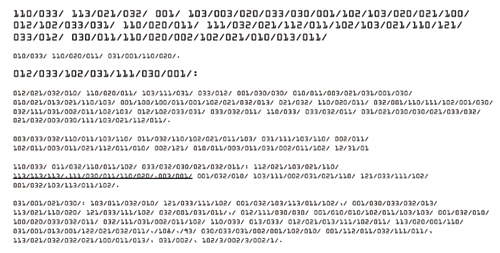
To generate interest, the U of L's Mathematics and Computer Science Department, Faculty of Arts and Science, and campus recruitment office launched the "Go Figure" contest, which challenged high-school students to decipher an encrypted message, then solve the resulting math problem. The Base4 problem, created by computer-science professor Wolfgang Holzmann, substituted three-digit numbers for letters in the alphabet. If students had problems with the problem, they could ask for advice. Admittedly, the code wasn't that tough to crack, but then the goal wasn't to replace the Advanced Encryption Standard either. Upon submitting their solutions, students became eligible for scholarships of up to $3500. Before the contest ended on February 1, more than 1000 students tackled the problem — with more than 100 solving it. And with that in mind, please join me in congratulating Tara Pugh of Penticton, British Columbia, this year's first-place scholarship winner, and second-place winner Derek Joyal of Calgary, Alberta.
According to Barbara Williams, coordinator for student recruitment, the university is committed to the contest and has already started planning for next year's event. Accolades are due the university for its commitment and creativity. We need to see more of both.
Jonathan Erickson
editor-in-chief
jerickson@ddj.com