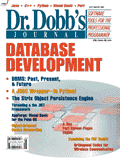
From ISAM to XML, data has proven to be the power that runs businesses. Ken examines the database landscape to see where we've been — and where we will be going.
Microsoft's .NET Framework offers a number of features, such as threading, that simplify difficult tasks.
Strix, a software layer that works between an application and the relational database back end, interfaces relational databases with object-oriented programming languages.
Database access via JDBC can be less than straightforward. To simplify the process, C.K. presents a Python-based framework that wraps around JDBC.
AppForge was developed as an add-in to the standard Visual Basic 6 IDE. Clayton uses it to build a database for the Palm OS.
Michael presents an object-oriented approach that is an alternative to the traditional ways of designing networked devices.
Perl Server Pages is a small footprint Perl-based cross-platform JSP-like facility for generating dynamic pages for both UNIX and Windows.
Lauren shows how you can use Adobe's Forms Data Format (FDF) Toolkit to make PDF documents come alive.
Was Bill Gates a good programmer? What does Prolog have to do with the Semantic Web? And what did Kent Beck have for lunch?
There's nothing like a comment or two about programmer's editors to fill up the mailbag.
Every real-time project starts with a design point that determines what's to be included and — more importantly — what's to be left out of the final product.
Is JavaScript an object-oriented language? Well, it does utilize prototype-based inheritance and support encapsulation.
Orthogonal codes are sets of sequences extensively used in wireless communication.
It isn't the Star Wars project, but the Air Force still has a base to protect and Ecco and Liane are called upon to help.
Peter examines a pair of C++ books — C++Builder 5 Developer's Guide and C++ and Object-Oriented Numeric Computing for Scientists and Engineers.
and Della Song