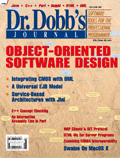
The goal of the Coats-Mellon Operational Specification (CMOS) is to provide a rigorous, yet straightforward, approach to defining system behavior early in the software-development process. Mark and Terry apply CMOS to the Unified Modeling Language.
Entity EJBs generally come in two varieties: container-managed persistent and bean-managed persistent. Our authors propose a third flavor, the Universum Bean.
Object-oriented schemes such as service-based architectures built on Sun's Jini framework for distributed services provide more flexibility than the traditional client-server model.
The flexibility provided by C++ templates generally comes at the expense of type safety. Jeremy and Andrew present a technique for reintroducing type safety into template functions.
How would you go about organizing thousands of daily news stories from hundreds of Internet-based sources? Ray turned to Perl's pattern-matching capabilities to cull, tag, sort, and present all the news that's fit.
Our authors examine both the Secure Electronic Transaction (SET) protocol and the Wireless Application Protocol (WAP), then present a model that uses WAP to support SET with a SET thin client and smartcard technology.
Morgan examines a combination of the Unified Modeling Language (UML) and Specification and Description Language (SDL) that forms a modeling paradigm for visual software engineering that is superior to either language by itself.
Creating native client interfaces for multiple platforms can be a costly process. Michael's solution is to create a single HTML UI for server applications running on both Apache Web Server 1.3.14 and Microsoft's Internet Information Services 5.0 (IIS).
Our authors present conclusions from a study of ORB interoperability and code portability to determine the feasibility of CORBA as an interoperable standard for both new and legacy code within mobile and/or embedded computing environments, and to create a working demonstration of the mobile/embedded environment using CORBA.
Michael takes a look at Apple's new MacOS X operating system, then puts Wolfram's CalculationCenter (which Michael sees as a mathematical tool for the rest of us) to work.
What with drivers, editors, Linux, mail, and more, Al adds a new meaning to the term "multitasking."
A trip to the bright lights of the LinuxWorld Expo gets Ed thinking about the world of embedded Linux.
Can Java handle multiline strings? Yes, and Brad shows you how.
Shawn presents strategies to adapt a generally memory-intensive recursive algorithm for use in environments where memory may be limited and reusability is required.
It's probably a mistake to tell shipping-magnate Katy McLean that she floats your boat, but that doesn't mean she isn't looking for the most efficient port in a storm.
Doug examines a trio of SQL books, including Inside Microsoft SQL Server 2000, by Kalen Delaney; Advanced Transact-SQL Programming for SQL Server 2000, by Itzik Ben-Gan and Tom Moreau; and Robert Vieira's Professional SQL Server 2000 Programming.