|
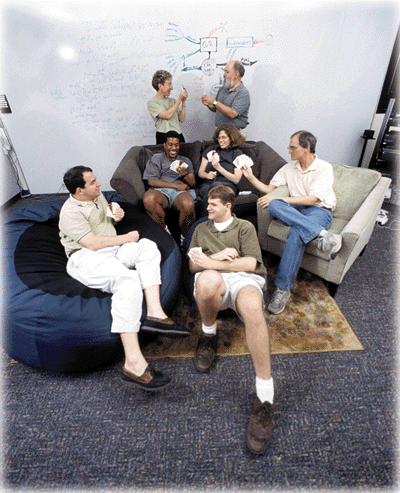
| Secure Document Systems group. From left to right, row 1: Drew Dean, Adam Stubblefield; row 2: Paul Stewart, Diana Smetters, Matt Franklin; row 3: Teresa Lunt, Tom Berson. |
Imagine a near future in which cryptographic operations are dirt cheap and plentiful. Then imagine what scientific questions would be raised and answered by that future. How would engineering tradeoffs change or what sorts of new businesses would be made possible? What would it mean to individuals, and just as importantly, what would it mean to groups?
The received wisdom about cryptography is that it is difficult and expensive. This has led to system design and engineering tradeoffs that aim to minimize the use of cryptography, particularly public-key operations, because they are computationally expensive.
But the world that led to this received wisdom has changed, and a great many influences are combining to make cryptography easier and cheaper. These influences include the professionalization of cryptographers, the creation of university courses, the steady growth of computational power (that is, Moore's Law), algorithmic advances made by cryptographic researchers, the rise of e-commerce and wireless infrastructures with their seemingly endless appetite for cryptographic services, the entry of many young people into the field, and the easing of government export controls.
The Secure Document Systems group at PARC is exploring a future in which cryptographic operations will be as pervasive, inexpensive, and unremarkable as IP protocol operations are today. We are following a traditional PARC paradigm of building future gadgets and services now, no matter how uneconomical that may be, in order to study the impact of those gadgets and services on people, on organizations, and on systems. We use this approach to identify and explore scientific, technical, economic, and social consequences of this possible future.
We began our exploration of the abundant cryptographic future by building a time machine. This machine makes a canonical "expensive" cryptographic operation -- modular exponentiation -- fast, cheap, and ubiquitous. Instead of providing everyone at PARC with their own hardware cryptographic accelerator, we are providing these critical cryptographic operations as a network service. We have designed and built, at substantial cost, a fast "cryptoserver" for public-key operations. This cryptoserver is equipped with a number of hardware cryptographic accelerators, which may be shared among a large number of clients amortizing the cost and allowing even those clients who perform very few cryptographic operations to benefit from hardware speedups today. As part of our project, we have built interfaces to our cryptoserver, and made its services available to our colleagues over the PARC network. Time travelers are now using the cryptoserver and are discovering the many ways in which it can make a difference.
To help explore life in a future of cryptographic abundance, we organized a public symposium at PARC in the summer of 2000 and have made the results available at http://www.parc.xerox.com/crypto-symposium/. A link on that page will let you join our list for announcements of further events.
Current members of the Secure Document Systems group are: Tom Berson (cryptography, computer security, use and abuse of secrets); Drew Dean (systems security); Matt Franklin (cryptography, distributed computing); Teresa Lunt (database security, intrusion detection); Diana Smetters (cryptographic engineering, PKIs, handheld and wireless devices); and Paul Stewart (gadgets). Our interns this year are Michel Abdalla, Michael Semanko, and Adam Stubblefield.
-- T.B., D.D., M.F., T.L., D.S., P.S., and A.S.
Back to Article