|
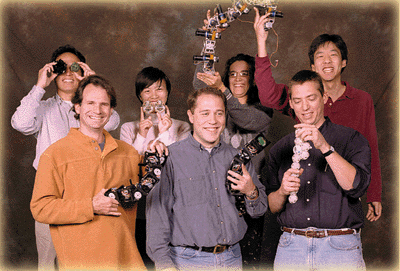
| The Modular Robotics group. From left to right, top row: John Suh, Ying Zhang, Arancha Casal, Mark Yim; bottom row: David Duff, Kimon Roufas, Sam Homens. |
Traditional robotics is usually about designing and building specialized, intelligent machines to perform a limited set of tasks in specific environments. Given the current state of the art, these robots work well in their intended jobs but often do not do well when placed in new settings. Modular robotics, which is the subject of our research, represents a dramatic change in the way robots can be designed, built, and used. The general concept is to build many copies of one simple module and then to assemble a great number of these modules into a large, complex robot. The modules themselves can't do much, but when multiples of these modules are connected together, the resulting system can do complicated and unexpected things. In other words, a modular robot seeks to take advantage of synergy, where the whole is greater and often different than the sum of its individual parts. Furthermore, as a direct consequence of the modularity itself, we are also able to explore robots that can reconfigure their own shapes and structures. Such shape-shifting robots can alter their abilities by moving their modules to different locations on their own bodies to meet the demands of different tasks or different working environments.
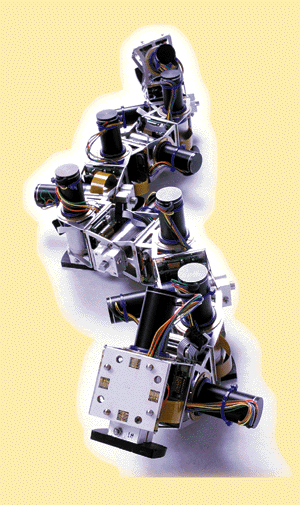 |
| The Polybot. |
We are currently working on two different types of modular, reconfigurable robots -- Polybot and Proteo. Polybot is a mobile robot that takes one of three shapes -- a snake, rolling loop, or spider -- depending on the terrain. For example, on smooth, level ground, a rolling loop is best, while for steps, a snake or spider shape would work better. Applications for Polybot include planetary surface exploration and search and rescue in dangerous environments. On the other hand, Proteo is not intended as a mobile robot, but rather as a shape-shifting device that can take on various 3D forms such as a bridge or a container. Presently, hardware prototypes of both kinds of robots have been built and newer versions are being designed. While these kinds of robots can be scalable in terms of number of modules, our goals are to demonstrate a 200 module Polybot and a 20 module Proteo in the year 2001.
The Modular Robotics project is a cross-disciplinary PARC project. Seven researchers are in the Systems and Practices Lab (SPL) at PARC. The project is lead by Mark Yim, whose doctoral work at Stanford University provided the inspiration for this work. The other members of the SPL team include Arancha Casal, David Duff, Sam Homens, Kimon Roufas, John Suh, and Ying Zhang. Casal and Zhang work primarily in the software side of the project developing solutions for control, locomotion, and reconfiguration planning, while Roufas is primarily focused on the mechatronic aspects (low-level software and electronics). Duff, Homens, and Suh work on the mechanical hardware, including the module's structure, actuators, and mechanical couplers. In addition to this core team, many other researchers across PARC contribute their expertise including Markus Fromherz (control), David Goldberg (algorithms), and Tad Hogg (planning software), not to mention various summer interns, visiting scholars, and hallway conversationalists who provide valuable input of ideas and energy.
-- A.C., D.D., S.H., K.R., J.S., M.Y., and Y.Z.
Back to Article