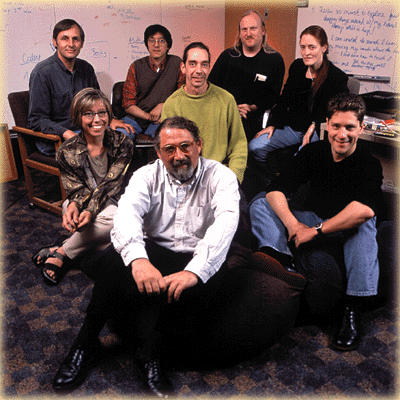
The Research in Experimental Documents (RED) group is a unit within Xerox PARC with a unique charter to study -- and develop -- new document types and genres. It pursues this work by creating real documents using new and emerging technologies from PARC, Xerox, and the world. As much as possible, these works are presented to real users in public settings and intended to be engaging, evocative, and fun. This research is critical because it is known that there are strong feedback loops between new communication technologies and the content that they can (or will) present. Trying to design the next generation of television, Web, or printer without also simultaneously designing the next generation of television show, web page, or book is a fairly hopeless task when the cycles of development are as fast as they are in the current internetted world.
|
| The Experiemental Documents group. From left to right, row 1: Rich Gold; row 2: Anne Balsamo, Scott Minneman, Matt Gorbet; row 3: Steve Harrison, Mark Chow, Dale MacDonald, Maribeth Back. |
RED's methodology is called "speculative design and engineering." What is speculated upon is a world and social milieu that doesn't yet exist, where traditional means of design and engineering employing user testing and customer engagement are not possible (the document artifacts, on the other hand, are quite real and are not speculations). Instead, RED draws deeply from the traditions of art and science to provide the impetus for its design and engineering decisions.
It is often thought that the line between art and science is difficult to cross. But, as our work with the PARC Artist-In-Residence (PAIR) program shows, artists and scientists have much in common -- they both talk of vision, of the cutting edge, of truth, and of saving the world. On the other hand, the distinctions between art and design (and between science and engineering) are profound, and there is usually some antipathy between the two. For example, artists find the idea of user testing anathema (for example, what does it mean to do user testing on the Mona Lisa), while designers who don't do user testing are just bad designers. Hence, for RED, working as a speculative design group, it requires the intersection and communication of all four of these creative professions to succeed.
RED's current project is called "Experiments in the Future of Reading" (XFR) (http://www.parc.xerox.com/xfr/), in which we are looking deeply at the issues surrounding how new technologies will effect and change reading. Most interestingly, we are studying a "nonconvergent" future where there is an explosion of new media and where the content and media blur together. As a means of exploration, we recently displayed 12 new reading exhibits at The Tech Museum of Innovation in San Jose, California. These include tables that tilt to scroll through large documents; books you can read and listen to; stories in hyperbolic space; long timelines with magic lenses that move; and even a comic book you can walk into.
RED's diverse members are Rich Gold (art, toy design, ubiquitous computing, and the author of this article); Maribeth Back (sound design, interface design, theater); Anne Balsamo (multimedia design, literature, cultural theory); Mark Chow (video, music, multimedia); Matt Gorbet (interface design, programming, graphic arts); Steve Harrison (architecture, work studies, physical design); Dale MacDonald (computer systems, lighting, visual arts); and Scott Minneman (mechanical engineering and design, collaborative studies, and embedded systems). Needless to say, developing a common language is our most challenging endeavor.
-- R.G.
Back to Article