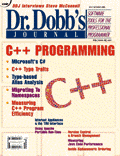
Microsoft's C# programming language promises the power of C++ with the productivity of Visual Basic. Scott builds a Stack class that demonstrates important aspects of the language.
Generic programming does not have to sink to the lowest common denominator. And therein lies the value of type traits.
If you aren't familiar with C++ namespaces, you should be because most compilers now support them.
Aliasing issues make it difficult for compilers to generate code that runs as fast as you might hope. Luckily, the C++ type system makes clear what can and cannot alias.
Our authors describe an interactive C++ metrics tool that makes automated metrics gathering a natural part of the development process.
MACtimes are perhaps one of the most potentially valuable forensic tools in your digital detective toolkit. Dan shows how to use them.
Steve McConnell takes time to talk with us about what it means to be a programmer, entrepreneur, consultant, educator, author, and editor.
Need to build an Internet appliance? Dallas Semiconductor's Tiny InterNet Interface (TINI) board -- that includes a Java-capable CPU, 512 K of nonvolatile memory, and an Ethernet transceiver -- may be the place to start.
James and William present techniques they've developed to achieve portability of a real-time signal processing software system consisting of over 300,000 lines of C code.
Ryan examines the Apache Portable Run-Time, a library that is designed to address the Apache web server's portability problems.
Michael describes how branching and merging works in CVS, a widely used GNU source-code control system.
Zombies come out of the woodwork as Michael looks at the history of the personal computer.
Al shares what he heard at the annual Shareware Conference.
How can you measure Java code performance? Karl examines techniques for instrumenting Java code at run time.
David first presents a simple alphanumeric-ordering function, then describes another function suitable for comparing long filenames.
Saving the X-mammal is the challenge that Liane and Dr. Ecco face this month.
Books about the C++ STL are Peter's focus, as he examines STL for C++ Programmers, by Leen Ammeraal; Data Structure Programming, by Joseph Bergin; Designing Components With The C++ STL, by Ulrich Breymann; Data Structures In C++ Using The STL, by Timothy Budd; and Using the STL, by Robert Robson.