Dr. Dobb's Journal October 1999
So, what do Redmond, Washington and Eleva, Wisconsin have in common? The answer: The local economies of both communities are dominated by a single software company. Okay, so both towns are in states that begin with "W" too. That's where the similarities end, however. Redmond, for instance, sports a population of more than 45,000, covers 16 square miles, has over 500 city employees, a municipal operating budget in excess of $100 million and at least 4000 business licenses. Eleva has a population of 491, one stoplight, four churches, and Pammy K's cafe.
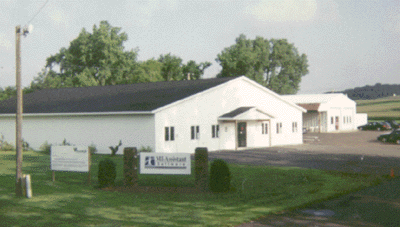
But then Redmond has Microsoft. With 30,000 employees, 5 million square feet of office space, and $15 billion a year in net revenue, Microsoft isn't just big -- it's monstrous.
Eleva, on the other hand, has MI-Assistant Software (http://www.mi-assistant.com/). With 80 employees housed in 11,000 square feet of office space, MI produces Windows-based management software for insurance agents. The company currently serves more than 1500 independent agents throughout the Midwest, as well as 23,000 company agents throughout 40 states.
Unlike Redmond, which has evolved into some sort of high-tech Mecca for large employers like Nintendo and AT&T, Eleva is situated in the middle of a farming community. The kind of place, in other words, you'd expect to build a business in, say, lawn mowers, snowmobiles, or farm machinery, rather than software. But unlike other industries, software isn't geographically tied to a nearby river or coal seam. In today's world, you can write software and build businesses anywhere -- even in little Eleva.
Yes, by Microsoft standards, MI is a small fish in a small pond. Still, the company is doing something right. MI is celebrating its 15th anniversary this year, and boasts a 97 percent client retention rate. Not bad for an operation that started out as one man in a basement, especially when all Jim Deetz (MI's founder and president) set out to do was to write a program that lets insurance agents enter driver/vehicle information into a computer, then compute premiums. What he ended up becoming was Eleva's largest employer, providing livelihoods for dozens of families, including his sons Stephen and Scott, who serve as vice president/programming and vice president/sales and marketing, respectively.
Still, it hasn't been easy, especially when it comes to issues such as finding and keeping talented programmers, of which MI currently employs 25. Of course, with a university and a two-year technical college just 20 minutes up the road in Eau Claire, the company is luckier than many businesses in rural communities. And, like most small software houses (and unlike some bigger ones), MI has found that "good" isn't good enough -- software has to work the way it's supposed to, the first time, every time. In niche markets like MI's, users won't pay to be beta testers -- they'll just go elsewhere. Nor do small software companies have the luxury of expanding beyond their niche; the risk is just too great. On the upside, this also means that small software companies can focus more intensely on customer needs. With these challenges and more, it's no surprise that companies (like MI) that have successfully navigated commercial minefields are the exception, rather than the rule.
In 1997, however, MI faced a crossroads. The company was growing fast, and needed room to expand. At the same time, Deetz and his management team recognized the danger in putting up a $300,000 building in such a small town. In truth, Deetz didn't want to abandon the small-town atmosphere of Eleva for the hustle of a larger city. Luckily, village leaders understood MI's value to the community, and took steps to keep it in Eleva. Led by village President Glenn Schriener, the community applied to the state of Wisconsin for a community development block grant, which was approved by Governor Tommy Thompson. The grant made it possible for the village to purchase land and construct a building tailored for MI. In return, the company signed a seven-year lease, with additional space reserved for expansion of up to 150 employees. In the end, everyone won -- the village, the company, the employees, and MI's customers.
What this all comes down to is that, for small software companies, success doesn't come easy. To stay competitive, innovative ideas -- both in terms of business and technology -- are important, the loyalty and support of employees, customers, and the community are critical, and customer service is everything. Say, now that you think about it, that's something big businesses might mull over, too.
Jonathan Erickson
editor-in-chief
jerickson@ddj.com